

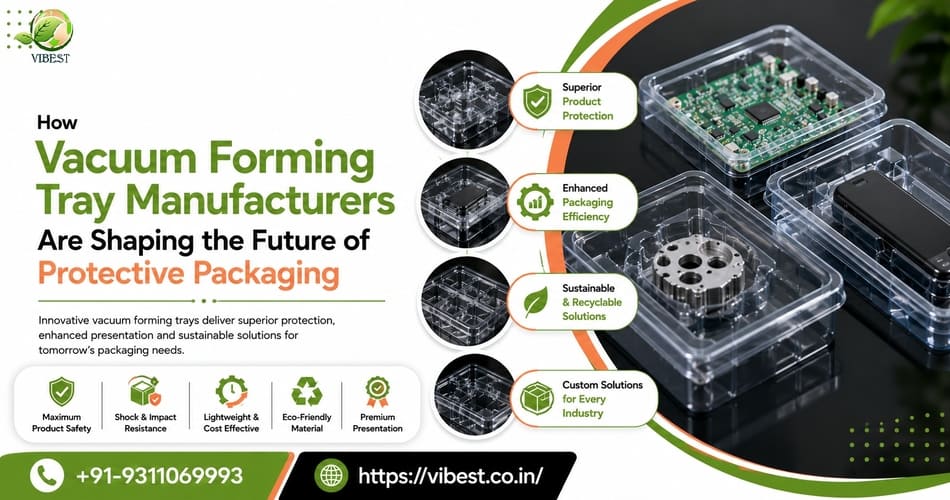
Packaging requirements have changed significantly as businesses look for safer, lighter, and more efficient ways to protect products throughout storage and transportation. From automotive components and electronics to food items and industrial parts, manufacturers need packaging that fits products securely while supporting smooth handling and logistics. This growing requirement has increased the importance of experienced Vacuum Forming Tray Manufacturers that can develop practical and customized solutions for different applications.
A well-designed Vacuum Forming Tray for packaging can provide product stability, organized storage, and protection against movement during transportation. The technology also allows manufacturers to create trays in different shapes and sizes, making it suitable for businesses with specialized packaging requirements.
Vibest International is part of this evolving packaging industry, providing thermoformed packaging solutions designed around product-specific requirements and modern manufacturing needs.
What Is Vacuum Forming?
Vacuum forming is a thermoforming process in which a plastic sheet is heated until it becomes flexible and then shaped over a mold using vacuum pressure. Once the material cools, it retains the shape of the mold and creates a lightweight, durable packaging component.
This manufacturing technique is widely used to produce trays, containers, inserts, and protective packaging. The process allows businesses to develop packaging designs that closely match the dimensions and contours of their products.
For industries handling delicate or precision components, this customized approach can be particularly valuable because the tray can be designed to minimize product movement.
Why Vacuum Forming Trays Are Gaining Popularity
The demand for vacuum-formed trays is growing because modern supply chains require packaging that combines protection with operational efficiency. Conventional packaging may leave products exposed to movement or require additional protective materials.
A properly designed tray can help address these challenges by providing:
- Secure product positioning
- Individual compartments for multiple components
- Efficient stacking and storage
- Reduced movement during transportation
- Lightweight construction
- Customized dimensions
These benefits have made vacuum forming an attractive option for companies seeking reliable protective packaging.
The Role of Vacuum Forming Tray Manufacturers
Professional Vacuum Forming Tray Manufacturers play an important role in converting product requirements into functional packaging designs. The manufacturing process generally begins with understanding the product's dimensions, weight, fragility, and intended supply chain environment.
Manufacturers may then develop a suitable mold and select an appropriate material based on the application. Prototypes can be evaluated before large-scale production begins.
This approach helps businesses identify design improvements at an early stage and ensures that the final tray performs effectively during handling and transportation.
Applications Across Different Industries
Vacuum-formed trays are highly versatile and can be adapted to a wide range of products.
- Electronics and Electrical Components
Sensitive components require packaging that reduces scratches, impact, and unnecessary movement. Customized cavities can keep individual parts separated and organized.
- Automotive and Engineering Parts
Small mechanical components, assemblies, and precision-engineered products can benefit from structured trays that simplify transportation and inventory management.
- Food and Consumer Packaging
Depending on material selection and applicable food-contact requirements, thermoformed trays can be used for certain food and retail applications where product visibility and organized presentation are important.
- Medical and Healthcare Products
Medical equipment and specialized components may require precisely shaped packaging inserts to maintain product positioning during distribution.
- Industrial Manufacturing
Industrial businesses often handle products with unusual shapes or dimensions. Custom vacuum-formed trays provide greater flexibility than standard packaging formats.
How a Vacuum Forming Tray Improves Packaging Efficiency
The right Vacuum Forming Tray for packaging can contribute to efficiency throughout the supply chain.
- Better Product Organization
Products remain in designated positions, making handling and inventory management easier.
- Reduced Transit Damage
A customized cavity can help absorb movement and prevent products from shifting excessively during transportation.
- Efficient Warehouse Storage
Stackable tray designs can help businesses make better use of available storage space.
- Faster Handling
When products are organized within dedicated cavities, workers can identify, pick, and move items more efficiently.
- Reduced Secondary Packaging
A well-engineered tray may reduce the need for additional protective materials, depending on the product and application.
These advantages demonstrate why businesses increasingly consider vacuum forming when planning modern packaging systems.
Customization Is Central to Vacuum Forming
One of the most valuable advantages of vacuum forming is design flexibility. Products vary considerably in shape, size, and weight, so packaging must often be customized accordingly.
A tray can be designed with:
- Multiple product cavities
- Different cavity depths
- Rounded or contoured edges
- Stackable structures
- Reinforced sections
- Product-specific compartments
For manufacturers, customization means packaging can be developed around the actual product rather than forcing the product to fit a standard tray.
Experienced Vacuum Forming Tray Manufacturers work closely with businesses to understand these requirements and develop designs that balance protection, usability, and production efficiency.
Choosing the Right Material
Material selection has a direct influence on tray performance. Depending on the intended application, manufacturers may consider materials such as PET, PVC, HIPS, PP, or other thermoforming plastics.
The choice depends on several factors, including:
- Product weight
- Required rigidity
- Transparency requirements
- Impact resistance
- Temperature exposure
- Industry-specific standards
Selecting the right material ensures that the tray can withstand the conditions it is expected to encounter during packaging, storage, and transportation.
Quality Control in Vacuum Formed Tray Production
Consistency is essential when packaging is used in large-scale manufacturing operations. Small variations in dimensions can affect product fit and packaging-line efficiency.
Reliable manufacturers focus on quality checks such as:
- Dimensional accuracy
- Material thickness
- Surface quality
- Cavity consistency
- Structural strength
- Product fit and alignment
A systematic quality process helps businesses maintain uniform packaging performance across production batches.
Why Vibest International Is a Reliable Packaging Partner
Businesses looking for customized thermoformed packaging solutions require a manufacturing partner that understands both technical and commercial requirements. Vibest International focuses on developing packaging solutions based on individual product applications.
The company emphasizes:
- Customized tray development
- Precision thermoforming
- Consistent manufacturing quality
- Product-specific designs
- Practical packaging solutions
- Support for diverse industrial applications
By combining technical understanding with a focus on application requirements, Vibest International helps businesses explore packaging formats that support product protection and operational efficiency.
Sustainability and Material Efficiency
Sustainability is becoming increasingly important in packaging decisions. Businesses are looking for ways to reduce unnecessary material consumption while maintaining adequate product protection.
Vacuum forming can support material efficiency through optimized designs that use plastic where structural support is actually required. Lightweight tray designs may also reduce overall packaging weight, potentially contributing to more efficient transportation.
Where suitable for the application, recyclable materials can further support responsible packaging strategies. However, businesses should always consider the complete product lifecycle, including collection and recycling infrastructure, when evaluating environmental performance.
What to Consider Before Ordering Vacuum Forming Trays
Before selecting a supplier, businesses should evaluate several important factors:
- Product dimensions and weight – These determine the tray's structural requirements.
- Transportation conditions – Long-distance shipping may require additional protection.
- Storage requirements – Stack ability can be important for warehouse efficiency.
- Material suitability – The selected material should match the application's needs.
- Production volume – Manufacturing capacity should align with expected demand.
- Customization capability – Complex products may require specialized moulds and designs.
Careful planning at the beginning can help businesses achieve better packaging performance and reduce unnecessary redesign costs.
As industries become more focused on product safety, logistics efficiency, and customized packaging, vacuum forming has emerged as a versatile manufacturing technology. A well-designed Vacuum Formed Packaging Tray can help businesses improve product organization, reduce movement during transportation, and create more efficient handling systems.
The expertise of professional Packaging Tray Manufacturers is essential for developing packaging that matches specific product requirements. From material selection and mold development to quality control and final production, every stage contributes to the effectiveness of the finished tray.
With its focus on customized thermoformed packaging and application-oriented solutions, Vibest International supports businesses looking to improve their packaging systems through precision-engineered tray solutions. As packaging requirements continue to evolve, vacuum forming is likely to remain an important option for industries seeking a practical balance between protection, flexibility, and manufacturing efficiency.